
There is a particular ache that settles in when someone crosses a line you never quite knew how to name. You feel it in the chest, a quiet tightening, a hum of unease that lingers long after the moment has passed. Many of us have stood in that space, wondering why we said yes when every fiber of our being whispered no, or why we walked away from a conversation feeling hollowed out and unseen. Psychological boundaries are not walls we build to keep the world out. They are the living pulse of who we are, the quiet but firm declaration of what we will and will not carry. This guide will walk you through understanding, setting, and defending those boundaries, step by step.
Table of Contents
- Understanding psychological boundaries and their importance
- Preparing to set boundaries: Self-awareness and needs identification
- Setting boundaries: Practical communication strategies
- Recognizing and resisting manipulation: Keeping your boundaries secure
- Why boundary setting is harder than it seems (but worth it))
- Learn more about boundary defense and personal safety
- Frequently asked questions
Key Takeaways
| Point | Details |
|---|---|
| Boundaries protect well-being | Understanding and setting psychological boundaries safeguards your mental health and relationships. |
| Self-awareness is fundamental | Reflecting on your needs is the first step before setting effective boundaries. |
| Clear communication matters | Expressing your boundaries directly and firmly ensures others understand your limits. |
| Manipulation can breach boundaries | Recognizing tactics like guilt-tripping and gaslighting helps you stay secure. |
| Consistency is key | Boundaries only work when enforced consistently, even in the face of resistance. |
Understanding psychological boundaries and their importance
To understand psychological boundaries, we must first feel for them rather than simply define them. They are the invisible lines that separate your thoughts, emotions, and needs from those of the people around you. They exist in three primary forms: emotional boundaries, which protect your feelings from being dismissed or weaponized; mental boundaries, which guard your beliefs and values from being overridden; and physical boundaries, which define your comfort with personal space and touch.
Personal boundaries protect mental well-being and healthy relationships in ways that are both profound and practical. When your boundaries are clear, you move through the world with a kind of quiet confidence, a steadiness that others can feel. When they are unclear or absent, stress accumulates like sediment at the bottom of a river, slowly clouding everything.
How do you know if your boundaries need attention? Consider the following signs of weak or unclear limits:
- You often feel responsible for other people's emotions
- You say yes out of fear rather than genuine willingness
- You feel drained after most social interactions
- You struggle to express disagreement or discomfort
- You frequently feel taken advantage of, yet say nothing
Healthy boundaries, by contrast, bring remarkable gifts. They nurture self-worth, reduce anxiety, and create the conditions for relationships that feel genuinely reciprocal. The table below captures the contrast between weak and healthy boundaries at a glance.
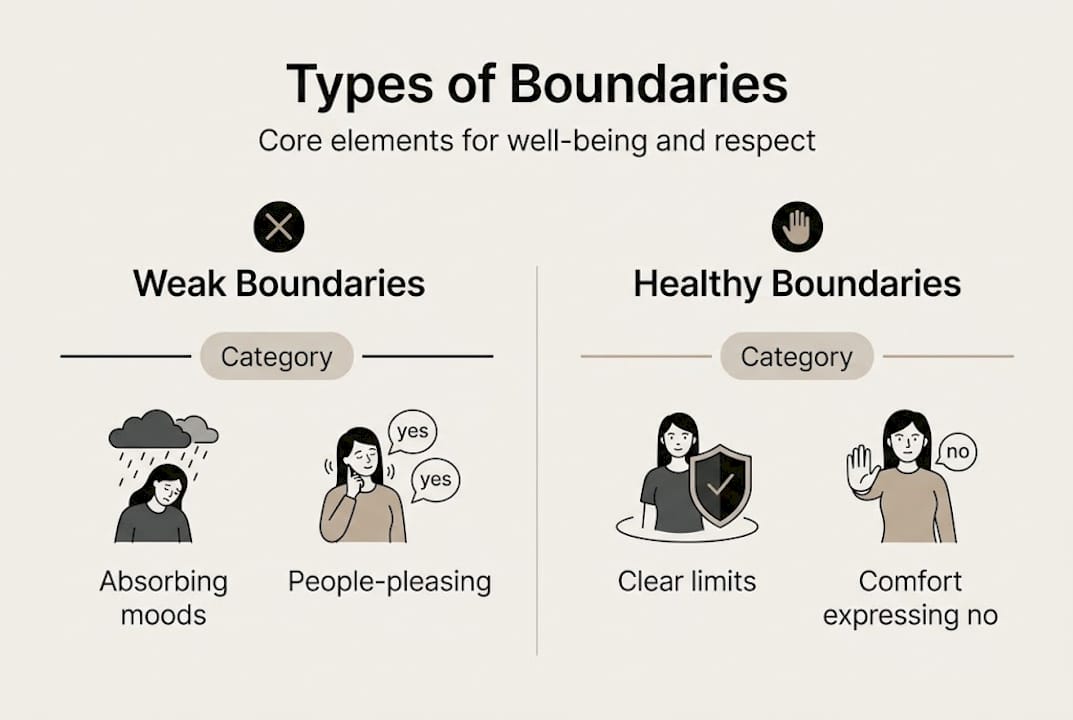
| Boundary type | Weak boundary signs | Healthy boundary signs |
|---|---|---|
| Emotional | Absorbing others' moods | Empathy without losing yourself |
| Mental | Abandoning your views under pressure | Holding beliefs while staying open |
| Physical | Tolerating unwanted contact | Communicating comfort clearly |
| Time | Overcommitting, never resting | Protecting your energy and schedule |
When we tend to our boundaries with care, we are not becoming cold or distant. We are becoming more fully ourselves, and that is a gift we offer to every relationship we hold dear.
Preparing to set boundaries: Self-awareness and needs identification
Before we can speak our boundaries aloud, we must first hear them within ourselves. Self-awareness is the first step in identifying the boundaries you need, and yet so many of us rush past this quiet, essential work. We reach for scripts and strategies before we have truly listened to what hurts, what depletes, what feels like a slow erosion of the self.
Begin by asking yourself a few honest questions. Where do you feel most resentful in your relationships? Which conversations leave you feeling smaller than when they began? What do you tolerate in silence that you wish you could name out loud? These questions are not comfortable, but they are illuminating. They reveal the geography of your inner life, the places where your needs have gone unmet and your voice has gone unheard.
To identify your boundary gaps, reflect on the following:
- Which relationships consistently leave you feeling exhausted or undervalued?
- What topics or behaviors trigger a physical reaction of tension or dread?
- Where do you feel you have given more than you have received, over and over?
- What would you protect fiercely if you believed you had the right to do so?
- What non-negotiables have you been quietly negotiating away?
Once you have sat with these questions, begin creating a clear list of your non-negotiables. These are the values, needs, and limits that, when violated, cause you genuine harm. They are not preferences. They are the bedrock of your psychological safety.
Triggers and discomfort cues are valuable signals, not weaknesses. When your stomach tightens during a conversation or you feel a sudden urge to disappear, your body is telling you something important. Learn to trust that pulse.
Pro Tip: Keep a journal for one week and record every moment you felt uncomfortable, dismissed, or pressured. Patterns will emerge with surprising clarity, and those patterns are your roadmap.
This preparation is not a detour. It is the very foundation upon which every boundary you set will stand or fall.
Setting boundaries: Practical communication strategies
With self-knowledge as your compass, you are ready to speak. Clear, firm communication and follow-through are vital for boundaries to work, and yet many of us have been taught, subtly and not so subtly, that expressing our needs is an act of aggression. It is not. It is an act of profound self-respect.

A simple and effective framework for expressing boundaries uses the structure: "If X happens, I will Y." For example, "If this conversation becomes disrespectful, I will end it and return when things are calmer." This approach is clear, calm, and free of blame. It places the focus on your response rather than the other person's character.
The table below shows the difference between indirect and direct boundary statements, and why directness serves you better.
| Approach | Example statement | Effect |
|---|---|---|
| Indirect | "I just feel a little uncomfortable sometimes" | Vague, easily dismissed |
| Direct | "I need you to stop interrupting me when I speak" | Clear, actionable, respectful |
Here is a step-by-step process for boundary conversations:
- Choose a calm moment, not the height of conflict
- State your boundary clearly and without apology
- Explain the impact, briefly and without blame
- Name the consequence if the boundary is crossed
- Follow through, every single time
With family, the work is often the most tender and the most necessary. Old patterns run deep, and the people who love us can also be the ones who test us most. With friends, directness preserves the relationship rather than threatening it. At work, framing boundaries around productivity and professionalism often eases the conversation.
Pro Tip: Rehearse your boundary statements with someone you trust before the real conversation. Hearing your own words spoken aloud makes them feel more real, and more yours.
Boundaries spoken with clarity and followed through with consistency become, over time, the quiet architecture of a life that feels genuinely your own.
Recognizing and resisting manipulation: Keeping your boundaries secure
Even the most carefully constructed boundary can be tested, and some people will test it deliberately. Manipulators use guilt-tripping, gaslighting, blame-shifting, and isolation to violate boundaries, and they often do so with a kind of practiced ease that can leave you questioning your own perception of reality.
Guilt-tripping makes you feel responsible for someone else's pain when you assert your needs. Gaslighting causes you to doubt your own memory and experience. Blame-shifting redirects accountability so that your boundary becomes the problem rather than the behavior that prompted it. Isolation quietly removes your support systems, leaving you more dependent and more vulnerable.
Manipulators focus on breaking boundaries because boundaries represent a loss of control over you. Power dynamics are at the heart of manipulation. When you hold your ground, you disrupt the dynamic they rely on, and that disruption is often met with escalation before it is met with acceptance.
Warning: If someone consistently dismisses your discomfort, reframes your limits as selfishness, or punishes you emotionally for saying no, these are early warning signs of a manipulative dynamic. Trust what you feel, even when you are told not to.
Here is an action plan for responding to manipulation:
- Name what you observe without accusation: "I notice this conversation shifts blame to me when I raise a concern"
- Restate your boundary calmly and without lengthy justification
- Refuse to engage with guilt or emotional pressure as a negotiating tool
- Document patterns over time, especially in professional or legal contexts
- Seek support from a trusted person or professional when the dynamic feels overwhelming
Research into manipulation in close relationships reveals that these tactics are far more common than most people realize, touching personal, professional, and familial bonds alike. Awareness is your first and most powerful defense.
Why boundary setting is harder than it seems (but worth it)
Most guides make boundary setting sound like a clean, linear process. Identify the need, speak the words, enforce the consequence. Done. But we know, from lived experience, that it rarely unfolds that way. There is grief in setting boundaries, a real and often unacknowledged grief for the version of yourself who kept the peace at any cost, and for the relationships that may shift or fracture when you begin to change.
The myth that boundaries are simply about saying no does a disservice to the genuine emotional labor involved. When you set a new boundary with someone who has known you without one, you are, in a sense, introducing them to a self they have never met. That can be disorienting for both of you.
There will be resistance. There will be moments when holding the line feels lonelier than letting it go. And there will be slow, quiet days when you wonder if it is worth the effort. It is. The long-term rewards for your mental health, your self-worth, and the quality of your relationships are not small. They are transformative. Progress does not always look like triumph. Sometimes it looks like simply holding on, and that is enough.
Learn more about boundary defense and personal safety
If this reflection has stirred something in you, a readiness to go deeper, to understand not just how to set boundaries but how to recognize the forces that work against them, then you are already moving in a meaningful direction.

The Psychology of Predators offers a rich and carefully researched exploration of the behaviors, tactics, and psychological dynamics that underlie manipulation and social predation. Jasen Y. Tham's work gives readers the kind of insight that transforms awareness into genuine protection. If you are ready to sharpen your instincts and fortify your understanding of how predatory dynamics operate in everyday life, this is a resource worth holding close.
Frequently asked questions
What are psychological boundaries?
Psychological boundaries are personal limits that protect your mental and emotional well-being by defining what is and isn't acceptable in your interactions with others. They exist across emotional, mental, and physical dimensions of your life.
How can I tell if someone is trying to manipulate my boundaries?
Common signs include guilt-tripping, gaslighting, shifting blame, and isolating you from support systems. Manipulators use guilt and isolation to erode your sense of what is reasonable and right.
What if my boundaries are ignored or challenged?
Consistently and calmly restate your boundaries, enforce consequences, and seek support if needed. Consistent follow-through is what gives a boundary its real weight over time.
Are boundaries the same as building walls?
No, boundaries protect without isolating. They are about healthy self-expression and communication, not shutting others out completely or withdrawing from connection.