
We tend to imagine harm as something we can see, something that leaves a mark on the skin or echoes in a room. But some of the deepest wounds are invisible, carved not by hands but by words, silences, and slow erosions of trust. Psychological abuse is a pattern of behavior intended to control or harm another person's mental or emotional well-being without physical violence, and it is far more common than most of us dare to acknowledge. It hums beneath ordinary life, quiet and persistent, shaping the way its victims see themselves and the world. This article will help you recognize it, understand its reach, and find your way back to clarity.
Table of Contents
- Defining psychological abuse and its core features
- Common tactics and behaviors used in psychological abuse
- Signs and symptoms: Recognizing psychological abuse
- Long-term effects and impacts on victims
- Nuances, edge cases, and the challenge of detection
- A deeper perspective: What most people (and experts) miss-miss)
- Learn more and protect yourself
- Frequently asked questions
Key Takeaways
| Point | Details |
|---|---|
| Hidden patterns matter | Abuse is often a sustained pattern of manipulation and control, not a single dramatic event. |
| Recognition is key | Identifying subtle signs early can prevent lasting harm to mental health and autonomy. |
| Global impact is huge | Psychological abuse is the most common form of violence, affecting billions worldwide. |
| Definitions can blur | Psychological and emotional abuse are often interchangeable and are treated similarly by experts and the law. |
| Resources help recovery | Expert guidance and supportive communities are vital for recognizing, escaping, and healing from psychological abuse. |
Defining psychological abuse and its core features
There is a particular ache that comes from harm you cannot name. You feel it in your chest before you understand it in your mind. Psychological abuse, also known as emotional or mental abuse, is a pattern of behavior intended to control and harm another person, and that distinction, pattern, matters enormously. A single unkind word is not abuse. What makes psychological abuse so corrosive is its repetition, its rhythm, its slow accumulation over time.
Unlike physical abuse, which leaves visible evidence, psychological abuse operates in the shadows. It can be dismissed, minimized, and denied, often by the very person inflicting it. This is what makes it so difficult to confront and so easy to endure far longer than anyone should.
"Psychological abuse is a pattern of behavior intended to control and harm another person's mental or emotional well-being, and it can be just as damaging, or more so, than physical violence." — WomensLaw.org
To understand the distinction more clearly, consider how psychological and physical abuse differ in their mechanisms and visibility:
| Feature | Psychological abuse | Physical abuse |
|---|---|---|
| Visibility | Invisible, internal | Often visible, external |
| Evidence | Difficult to document | Bruises, injuries |
| Duration of harm | Long-lasting, cumulative | Can be acute or chronic |
| Social recognition | Often minimized | More widely recognized |
| Legal clarity | Complex, emerging | More established |
The key features of psychological abuse include:
- Repetition: It is not a single event but a sustained pattern.
- Intent to control: The abuser seeks power over the victim's thoughts, feelings, or actions.
- Erosion of self: Over time, victims lose confidence in their own perceptions.
- Invisibility: It leaves no physical mark, which makes it easier to deny.
Understanding these features is the first step toward seeing what has, perhaps, been hiding in plain sight.
Common tactics and behaviors used in psychological abuse
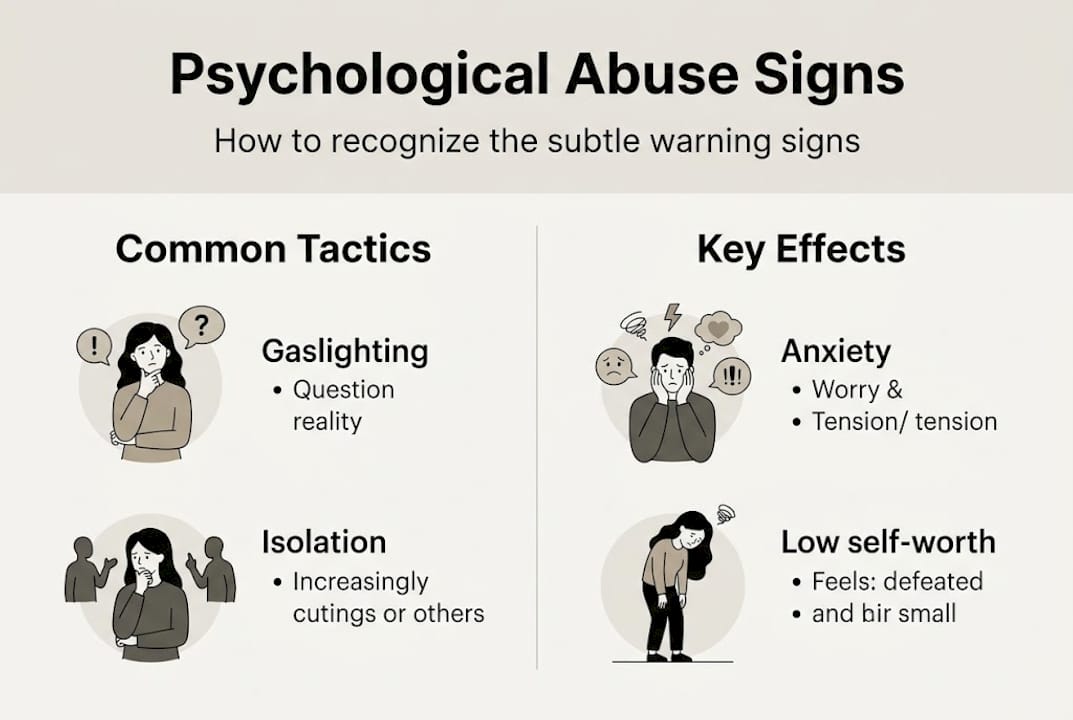
If psychological abuse is a pattern, then its tactics are the individual threads woven into that pattern. Each thread, on its own, might seem small. Together, they form something suffocating. Common tactics include gaslighting, name-calling, humiliation, isolation, threats, manipulation, and controlling behaviors, and each one serves the same quiet purpose: to diminish the victim's sense of reality and self.
Here is a closer look at the most frequently reported forms of psychological abuse:
- Gaslighting: The abuser causes the victim to question their own memory, perception, or sanity. "That never happened." "You're imagining things."
- Isolation: Cutting the victim off from friends, family, or support systems, making the abuser the sole source of reality.
- Humiliation: Public or private degradation designed to erode self-worth.
- Threats: Creating fear through implied or explicit consequences.
- Coercion: Pressuring someone into actions they would not freely choose.
- Controlling behaviors: Monitoring movements, finances, communication, or daily choices.
- Name-calling: Using language as a weapon to reduce a person to something less than they are.
Research reveals how often these tactics appear in reported cases:
| Tactic | Reported prevalence among victims |
|---|---|
| Emotional manipulation | 70%+ |
| Isolation from support | 60%+ |
| Humiliation or degradation | 55%+ |
| Threats and coercion | 50%+ |
| Gaslighting | 40%+ |
Pro Tip: Watch for behaviors that make you feel confused about your own memory or constantly apologetic for things that are not your fault. These subtle patterns often appear long before more obvious tactics emerge.
Signs and symptoms: Recognizing psychological abuse
Recognizing psychological abuse in yourself or someone you love can feel like trying to read a map in the dark. The signs are real, but they are easy to explain away, to attribute to stress, to personal failing, to sensitivity. Signs include withdrawal, excessive apologizing, anxiety around the abuser, isolation from support, low self-esteem, feeling controlled, and walking on eggshells. They pulse quietly beneath the surface of daily life.
Here are the most telling signs to watch for:
- Withdrawal from friends and family — a slow retreat from the people who once brought joy.
- Excessive apologizing — saying sorry for things that do not warrant an apology, almost reflexively.
- Anxiety or fear around a specific person — a physical tightening, a held breath, a careful choosing of words.
- Chronic self-doubt — questioning your own memory, judgment, or feelings constantly.
- Low self-esteem — a growing sense that you are not enough, not worthy, not capable.
- Feeling monitored or controlled — a loss of freedom in small, daily choices.
- Emotional numbness — a kind of hollowing out, where feelings become muted or distant.
These emotional abuse signs are not weaknesses. They are the natural responses of a mind trying to survive an environment of persistent threat.
Statistical callout: Psychological abuse is the most commonly reported form of intimate partner violence, affecting an estimated 50% of Americans at some point in their lives.
Pro Tip: Early warning signs are often dismissed as "relationship problems" or personality clashes. If you notice a pattern of feeling worse about yourself after interactions with a specific person, that pattern deserves your attention, not your justification.
Long-term effects and impacts on victims
The damage that psychological abuse leaves behind does not vanish when the relationship ends. It lingers, like an echo in an empty room, reshaping the way a person moves through the world. Psychological abuse is linked to PTSD, depression, anxiety, substance use, eating disorders, and physical symptoms like chronic pain, and research consistently suggests it can be more damaging over time than overt physical aggression.
The long-term impacts include:
- Post-traumatic stress disorder (PTSD): Flashbacks, hypervigilance, emotional dysregulation.
- Depression: A persistent heaviness, a loss of color in ordinary life.
- Anxiety disorders: Chronic worry, panic, a body that never fully relaxes.
- Substance use: Self-medication as a way to quiet the noise inside.
- Eating disorders: Control over food as a response to feeling out of control everywhere else.
- Chronic physical pain: The body holds what the mind cannot fully process.
- Damaged relationships: Difficulty trusting, connecting, or feeling safe with others.
"Globally, 43% of women worldwide have experienced psychological violence from an intimate partner, with rates varying between 20% and 75% across different regions."
The global abuse prevalence data paints a picture that is both staggering and sobering:
| Region | Estimated prevalence of psychological abuse |
|---|---|
| Global average | ~43% of women |
| United States | ~50% lifetime experience |
| Some regions | Up to 75% |
These numbers are not abstractions. They represent real people, real lives, real losses of self.

Nuances, edge cases, and the challenge of detection
Why does psychological abuse so often go unrecognized? Partly because we have been taught to look for the wrong things. We look for bruises, for raised voices, for dramatic scenes. But subtle forms of psychological abuse are often harder to detect and more harmful, and they occur in every kind of relationship, not only between intimate partners.
Consider some of the edge cases that complicate detection:
- Workplace abuse: A manager who systematically undermines an employee's confidence while maintaining plausible deniability.
- Family dynamics: A parent whose "concern" functions as control, whose "love" comes with conditions and surveillance.
- Friendships: A friend who belittles quietly, who isolates subtly, who makes you feel grateful for their presence while diminishing yours.
- Digital contexts: Online monitoring, harassment, and control through technology.
"There is no universal distinction between emotional and psychological abuse in research or law; measures may inconsistently include control behaviors, and coercive control is only beginning to be recognized as a distinct legal category in many jurisdictions."
The legal landscape is still catching up. Psychological violence indicators vary widely across countries and measurement tools, which means that what is recognized as abuse in one context may be invisible in another. This inconsistency is not a minor inconvenience. It is a barrier between victims and the help they need.
The challenge is also internal. Victims often normalize what they experience, because the abuse has been so gradual, so woven into the fabric of the relationship, that it no longer registers as extraordinary.
A deeper perspective: What most people (and experts) miss
We talk about psychological abuse in terms of emotional distress, and that framing, while important, misses something essential. The deepest wound of psychological abuse is not the sadness it creates. It is the freedom it takes. Coercive control is recognized in law as distinct, a pattern that deprives victims of liberty, and it is often more harmful and harder to address than any single act of aggression.
Conventional wisdom focuses on dramatic incidents, the argument that crosses a line, the threat that finally becomes undeniable. But the real machinery of psychological abuse is quieter. It works through accumulated small moments, each one deniable, each one easy to minimize. By the time a victim recognizes the pattern, their sense of self has already been reshaped by it.
What we miss, often, is that the goal of psychological abuse is not to cause pain. It is to cause dependence. The abuser does not want a broken victim. They want a compliant one. Understanding this distinction changes how we look for abuse, how we support survivors, and how we protect ourselves. Patterns matter more than incidents. Autonomy matters more than comfort. And the quiet erosion of self is the truest sign that something is deeply wrong.
Learn more and protect yourself
If something in this article stirred a recognition in you, a quiet ache of familiarity, know that you are not alone in that feeling. Understanding the mechanics of manipulation is one of the most powerful forms of protection we have.

The Psychology of Predators offers a deeper exploration of how predatory behaviors operate beneath the surface of ordinary relationships, how manipulation hides in plain sight, and how we can sharpen our instincts to recognize it before it takes root. If you are seeking to understand the psychology behind control and deception, this is a resource built with that exact purpose in mind. Knowledge, here, is not just power. It is safety.
Frequently asked questions
What is the difference between psychological and emotional abuse?
There is no universal distinction between the two; both involve controlling or harming someone's mental well-being and are treated similarly in legal and clinical contexts.
Can psychological abuse occur without physical violence?
Yes. Coercive control operates entirely through manipulation, threats, and behavioral control, with no physical violence required.
What are early signs of psychological abuse?
Some of the earliest signs include withdrawal and excessive apologizing, feeling anxious around a specific person, and a gradual isolation from friends or support networks.
Who can be affected by psychological abuse?
Anyone can be a target. Psychological abuse occurs in intimate relationships, families, workplaces, and friendships, regardless of age, gender, or background.
Is psychological abuse more common than physical abuse?
Yes. Psychological abuse is the most common form of intimate partner violence worldwide, affecting an estimated 50% of Americans over a lifetime and between 20% and 75% of women globally depending on the region.